

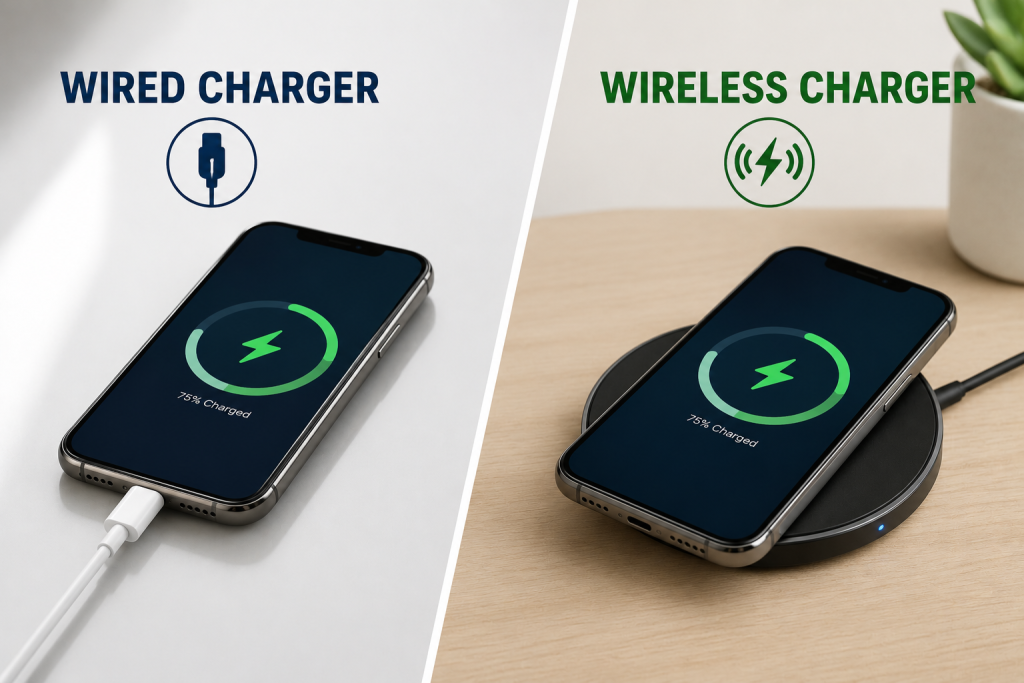
You grab your phone, notice the battery is nearly empty, and reach for a charger. This simple act has become a daily ritual, but the way you power up your devices is changing. While wired charging has been the standard for decades, wireless charging is now everywhere, from bedside tables to coffee shops. Deciding between a wired or wireless charger often comes down to what matters more to you: raw speed or pure convenience. Both options keep your devices running, but they do it in different ways. Understanding the strengths of each method helps you protect your battery and make your daily routine easier.
Understanding the Core Technologies
How Wired Chargers Deliver Power
A wired charger works by sending electrical current directly from a wall outlet, through an adapter, and into your device via a cable. The adapter converts high-voltage alternating current (AC) from your wall into the safer, lower-voltage direct current (DC) your phone needs. The cable carries this current straight into the device’s charging port. Modern chargers use smart technology to talk to your phone, figuring out exactly how much power it can safely handle. You will often see standards like USB Power Delivery (PD) or Qualcomm Quick Charge, which help devices charge as fast as possible without causing damage. The speed of this process is measured in watts, with higher wattage generally meaning faster charging.
The Magic Behind Wireless Charging
Wireless charging relies on a principle called electromagnetic induction. Instead of a physical cable, it uses two coils: one inside the charging pad and one inside your device. When you place your phone on the pad, the transmitter coil creates an electromagnetic field. The receiver coil in your phone picks up this field and turns it back into electricity to charge your battery. Most devices use the Qi standard, which ensures that your phone works with almost any wireless charging pad you buy. Because energy has to jump a gap rather than travel through a wire, it is naturally less efficient than a direct wired connection, which is why wireless charging is often slower and can produce more heat.
Speed and Efficiency Showdown
Wired Charging: The Speed King
If you need a quick charge before heading out the door, a wired connection is almost always the winner. Because the power moves directly into your device without the loss associated with air gaps, wired chargers can push high wattage efficiently. Many modern phones can go from zero to over 50% battery in less than 30 minutes when using a high-wattage power delivery charger. To get these speeds, check your phone manual to see which fast-charging protocols it supports. You should then pair it with a charger and cable rated for that specific protocol to get the best results.
Wireless Charging: The Convenience Trade-off
Wireless charging is rarely about speed; it is about ease. While it is improving, wireless charging is still generally slower than using a cable. Most standard wireless chargers operate at 5W to 15W, which is much lower than the 30W, 65W, or even higher speeds common with wired fast chargers. Because it is slower, wireless charging is best suited for scenarios where you have time, such as charging overnight on a nightstand or topping up while sitting at your desk. If your priority is a quick power boost, a cable is still the best tool for the job.
Portability and Convenience Factors
Wired Chargers: The Ultimate Travel Companion
For travelers, wired chargers are essential. A compact wall adapter with a detachable USB-C cable is lightweight, small, and versatile. A single, powerful USB-C PD charger can often charge your smartphone, tablet, and even a laptop, which saves significant space in your bag. Cables are also very reliable. You do not need to worry about lining up your device perfectly; just plug it in, and it starts charging immediately. Keeping a spare, high-quality cable and a small charger in your travel kit is a great way to ensure you never run out of power on the road.
Wireless Chargers: Declutter Your Space
The biggest advantage of wireless charging is aesthetics. If you are tired of tangled cables taking over your desk, nightstand, or kitchen counter, a wireless charging pad is a clean solution. You simply drop your phone onto the pad, and it starts charging without any fuss. This removes the need to hunt for the right cable or deal with frayed cords. For a truly organized look, many people prefer a multi-device wireless station that can charge a phone, watch, and earbuds all at once on a single pad, eliminating the mess of multiple wires entirely.
Durability and Device Health Considerations
Wired Charging: Wear and Tear
Frequent use of a wired charger does put physical stress on your device. Every time you insert and remove a cable, the charging port undergoes a bit of wear. Over years of use, this can lead to a loose port, making it hard to get a consistent charge, or damage to the cable itself. To make your cables and ports last longer, always hold the connector head instead of pulling on the cord, and avoid bending the cable sharply near the plug. Treating your cables with care is a simple way to extend their lifespan.
Wireless Charging: Reduced Port Stress
One often-overlooked benefit of wireless charging is that it completely removes physical stress from your device’s charging port. If you are someone who plugs and unplugs your phone dozens of times a day, switching to wireless can help your port last much longer. While wireless charging can generate more heat than wired methods, most modern chargers and phones are designed to manage this effectively. By reducing the physical wear and tear, you might find that your device remains in better condition over the long term.
Compatibility and Future-Proofing
Device Support for Wired Standards
Wired charging remains the most compatible method across all types of electronics. While older devices used a variety of different connectors, the industry has largely converged on USB-C. This is great news for you, as one cable can now charge almost everything you own, from wireless headphones to tablets and computers. When buying a wired charger, simply look for a high-quality USB-C unit that supports the Power Delivery (PD) standard. This ensures it will work safely and effectively with your current devices and most future ones you might buy.
The Rise of Qi and Beyond for Wireless
The Qi wireless charging standard has become the dominant technology, used by almost all major smartphone manufacturers today. When you see the Qi logo on a charger, you can be confident that it will work with your compatible phone. As the industry advances, new wireless standards are emerging that promise faster speeds and better alignment, making the technology more useful. Before you buy any wireless charger, always check your phone’s specifications to confirm that it supports the Qi standard to avoid any compatibility issues.
Making the Right Choice for You
Who Should Prioritize Wired Charging?
You should stick with wired charging if your top priority is speed. If you are a heavy user who needs to get your battery to 100% as fast as possible, nothing beats a high-wattage wired connection. Wired charging is also the right choice if you use older devices that lack wireless charging capabilities or if you travel frequently and need a single, reliable way to power up all your different gadgets with one compact wall adapter.
Who Benefits Most from Wireless Charging?
Wireless charging is perfect for you if you value convenience and a tidy space above all else. If you spend most of your day at a desk or want an easy way to charge your phone while you sleep, a wireless pad is ideal. It is also an excellent option if you are worried about wearing out your phone’s charging port or if you simply prefer not to deal with the hassle of finding and plugging in a cable every time your battery runs low.
Hybrid Approaches for Optimal Charging
For the best of both worlds, consider a hybrid approach. Many people keep a fast-charging wired adapter in their travel bag or near the door for quick, high-speed power boosts when needed. At the same time, they use a sleek wireless charging pad on their nightstand or desk for convenient, effortless charging during the day or overnight. By combining both methods, you ensure your devices are always ready, regardless of whether you have a few minutes for a quick charge or all night to power up.
| Feature | Wired Charger | Wireless Charger |
|---|---|---|
| Charging Speed | ⚡ Faster (up to 240W on supported devices) | 🐢 Slower (typically 5W–50W depending on device and charger) |
| Charging Efficiency | 90–98% efficient | 70–85% efficient due to energy loss |
| Convenience | Requires plugging in a cable | Just place the phone on the charging pad |
| Portability | Easy to carry; charger and cable required | Charging pad is bulkier and needs a flat surface |
| Heat Generation | Generates less heat | Generates more heat because of inductive charging |
| Cable Requirement | USB-C, Lightning, or other charging cable required | No cable connected to the phone while charging |
| Device Compatibility | Works with almost all phones using the correct cable | Only works with phones that support Qi or Qi2 wireless charging |
| Using the Phone While Charging | Easy to use while charging | Difficult if you lift the phone off the charging pad |
| Cost | More affordable | Usually more expensive |
| Durability | Cable may wear out over time | No cable wear on the phone’s charging port |
| Desk Setup | Cables can create clutter | Cleaner and more organized appearance |
| Travel Friendliness | Better for travel due to compact size | Less convenient because charging pads are bulkier |
| Energy Consumption | More energy-efficient | Slightly higher power loss |
| Safety | Very safe with certified chargers | Safe with certified chargers, but excess heat may reduce battery lifespan over time |
| Best For | Fast charging, gaming, travel, emergencies | Office desks, bedside tables, and daily convenience |
| Pros | Fast, efficient, affordable, universal | Convenient, cable-free, reduces charging port wear |
| Cons | Cable clutter, charging port can wear out | Slower, more expensive, generates more heat |
| Overall Verdict | Best choice if you prioritize speed, efficiency, and value | Best choice if you prioritize convenience and a cleaner setup |
Conclusion
Choosing between wireless and wired chargers is a strategic decision based on your habits and needs. Wired charging is the clear choice for speed and universal compatibility, making it indispensable for travel and quick top-ups. Wireless charging offers a level of convenience and simplicity that wired chargers cannot match, helping you keep your workspace organized while protecting your device’s charging port. By understanding the core strengths of each technology, you can curate a charging setup that fits your lifestyle perfectly, ensuring your devices stay powered up and ready for whatever you do next.